Learn SEO strategies to improve search rankings, increase organic traffic, optimise website performance, attract qualified visitors, and achieve sustainable online growth.
Introduction
Search Engine Optimisation (SEO) is one of the most important digital marketing strategies for businesses that want to build a strong online presence, attract potential customers, and achieve sustainable growth. In an increasingly competitive digital environment, simply creating a website is not enough. Businesses must ensure that their websites can be discovered by search engines, understood by their target audiences, and trusted by visitors. SEO provides a structured approach to improving website visibility and helping relevant pages appear when people search for information, products, or services.
Modern SEO involves much more than adding keywords to website content. It combines technical website optimisation, high-quality content creation, keyword research, search intent analysis, website architecture, user experience, link building, and performance measurement. Search engines use automated systems to discover, crawl, index, and rank web pages. Websites that provide useful information, demonstrate credibility, and offer accessible experiences have a stronger foundation for earning organic visibility. A successful SEO strategy therefore requires businesses to understand both their audience’s needs and the technical requirements of search engines.
At MyBlogPoster, the goal is to help businesses understand practical digital marketing strategies that support long-term online success. This guide explains how SEO works, how to develop an effective optimisation strategy, and how to improve website performance through ethical and sustainable techniques. Whether you operate a small business website, an e-commerce store, a professional service website, or a content-driven platform, understanding SEO can help you attract relevant visitors and turn organic traffic into meaningful business opportunities.
Understanding SEO and Its Importance for Online Business Growth
Search Engine Optimisation is the process of improving a website’s visibility in unpaid search engine results. It involves making website pages easier for search engines to discover, understand, and evaluate while ensuring that the content provides genuine value to visitors. When someone searches for a product, service, question, or solution, search engines attempt to display the most relevant and useful results. SEO helps businesses position their pages to compete for this visibility by improving content relevance, technical accessibility, website authority, and overall user experience. Unlike paid advertising, organic search visibility does not require businesses to pay for every click, although successful SEO still requires investment in research, content, technology, and ongoing improvements.
The importance of SEO comes from the way people use search engines throughout their buying journeys. Potential customers frequently research products, compare service providers, read educational articles, and investigate business solutions before making decisions. A well-optimised website can reach these users at different stages, from initial research to purchase consideration. For example, a person searching for website design advice may initially discover an educational article, later explore development services, and eventually contact a provider. This creates opportunities to build awareness, demonstrate expertise, and develop trust before a customer makes a purchasing decision. Businesses that consistently publish relevant information and maintain technically accessible websites can establish a stronger presence across these different search opportunities.
Another important advantage of SEO is its ability to support long-term marketing performance. A paid advertisement generally stops generating traffic when its campaign ends or its budget is exhausted. A useful organic landing page, however, may continue attracting visitors for an extended period when it remains relevant, competitive, and technically healthy. This does not mean organic rankings are permanent or guaranteed. Search algorithms, competitor activity, user expectations, and industry trends can change, making regular evaluation essential. Businesses should consider SEO a continuous investment rather than a one-time website activity. By combining useful content, reliable technical foundations, and responsible optimisation practices, organisations can create a sustainable source of relevant website traffic and improve their ability to compete in search results.
How Search Engines Discover, Crawl, Index, and Rank Websites
Understanding how search engines work is essential for developing an effective SEO strategy. The process generally involves three major stages: crawling, indexing, and serving search results through ranking systems. Crawling happens when automated search engine programs, commonly called crawlers or bots, discover publicly accessible web pages by following links and examining submitted sitemaps. These systems revisit pages to identify new content, updated information, and changes to existing website structures. A website with clear internal navigation, accessible pages, descriptive links, and a logical URL structure makes it easier for crawlers to discover important content. Technical problems such as broken links, server errors, incorrect redirects, and blocked resources can interfere with this process and prevent search engines from accessing valuable pages.
After discovering a page, a search engine may attempt to process and index its content. Indexing involves analysing information such as page text, titles, images, metadata, structured data, and other available signals to understand what the page contains. Not every discovered page is guaranteed to be indexed. Search engines may decide that certain pages provide limited value, duplicate existing information, or contain technical problems that make indexing unsuitable. Website owners should therefore avoid creating large numbers of unnecessary pages with little original value. Instead, they should focus on publishing useful content, maintaining consistent canonical signals where appropriate, and ensuring that important pages can be accessed without unnecessary technical restrictions. A properly configured XML sitemap can also help communicate the website’s preferred page URLs to search engines.
Ranking occurs when a search engine evaluates which available pages are most relevant and useful for a particular search query. Search systems consider many factors and automated signals, including the meaning of the query, content relevance, page quality, usability, context, and other applicable signals. There is no single ranking formula that guarantees success, and search engine systems continue to evolve. Businesses should avoid relying on outdated tricks or claims that one technical adjustment can automatically produce top rankings. Instead, they should build websites that serve users effectively and follow documented search engine recommendations. Google’s official SEO Starter Guide provides useful guidance on helping search engines understand website content and improving how pages appear in search results. Understanding these stages allows website owners to diagnose visibility problems more accurately and prioritise improvements that support long-term search performance.
Keyword Research and Identifying Valuable Search Opportunities
Keyword research is the process of discovering the words and phrases people use when searching for information, products, and services online. It provides the foundation for understanding audience interests and identifying opportunities to create relevant website content. A successful keyword strategy should focus on more than search volume. Businesses must also consider search intent, competition, topical relevance, customer needs, and the likelihood that a particular search can generate meaningful engagement or conversions. For example, a website selling professional SEO services may find that a phrase with moderate search volume and strong commercial intent is more valuable than a broad informational keyword attracting visitors who are unlikely to become customers.
A practical keyword research process begins with understanding the target audience and the problems they want to solve. Businesses can create an initial list of topics based on their products, services, customer questions, industry terminology, and frequently discussed challenges. Keyword research tools can then help identify related searches, estimated search demand, competition levels, and keyword variations. Google Keyword Planner, Google Search Console, and other reputable SEO platforms can provide useful information for evaluating opportunities. It is also valuable to examine search result pages to understand the type of content Google displays for particular queries. If the results mainly contain educational guides, creating a product sales page may not satisfy the search intent. Similarly, a commercial query may require service comparisons, product pages, or detailed purchasing information rather than a general informational article.
Businesses should organise keywords into meaningful topic groups instead of assigning every phrase to a separate page. For instance, a website focusing on technical SEO might identify related topics such as website crawling, XML sitemaps, indexing problems, page speed, mobile usability, and structured data. These subjects can be organised into a comprehensive content structure with supporting articles that address individual questions. Primary keywords should appear naturally in relevant locations, including page titles, headings, introductory paragraphs, and descriptive URLs when appropriate. Secondary and related terms can help explain the subject more comprehensively, but they should never be inserted unnaturally simply to increase keyword frequency. The objective is to create content that answers the audience’s questions clearly. A well-planned keyword strategy improves topical coverage, reduces unnecessary content duplication, and helps businesses attract visitors whose interests align with their offerings.
Understanding Search Intent and Matching Content to User Needs
Search intent describes the underlying reason behind a person’s search query. Two people may use similar words while looking for completely different types of information. One user might want to understand how SEO works, another might be comparing SEO agencies, and someone else may be ready to purchase an optimisation service. Search engines attempt to interpret these differences and display results that match the likely purpose of each search. Businesses that understand search intent can create more relevant pages, improve the usefulness of their content, and avoid targeting valuable keywords with unsuitable page formats. This is why search intent analysis should take place before content production rather than being treated as an optional editing step.
Search intent is commonly grouped into four broad categories: informational, navigational, commercial investigation, and transactional. Informational searches involve learning about a subject or finding an answer to a question, such as how to improve website rankings. Navigational searches involve finding a specific website, brand, or online destination. Commercial investigation searches occur when people compare potential solutions, providers, or products before making a decision. Transactional searches indicate stronger purchase or action intent, such as hiring an SEO consultant or purchasing a website optimisation package. These categories are useful planning tools, but real searches can contain overlapping motivations. A business should examine the actual search results and understand what users expect before deciding which content format is most appropriate.
Matching content to search intent requires selecting the right page type, structure, and level of detail. An informational keyword may be best served by an educational guide with practical explanations, examples, and frequently asked questions. A commercial investigation keyword may require a comparison article, service evaluation page, or detailed explanation of available options. A transactional query generally benefits from a focused landing page that clearly explains the service, pricing information where available, benefits, credibility, and next steps. Content should also provide an appropriate journey to related resources without forcing visitors into unnecessary sales messages. For example, an educational SEO article can naturally link to a technical SEO service page when the visitor needs professional assistance. By aligning each page with the audience’s actual needs, businesses can improve relevance, create more useful experiences, and attract visitors who are more likely to engage with their websites.
On-Page SEO: Optimising Website Content and HTML Elements
On-page SEO involves improving the individual elements of a website page so that search engines and visitors can understand its purpose. These elements include page titles, headings, written content, images, URLs, internal links, and relevant HTML attributes. A well-optimised page communicates its subject clearly without making the content difficult to read. The page title should accurately describe the main topic and provide a compelling reason for users to visit. It should be distinctive, concise, and relevant to the actual page content. Meta descriptions can summarise the page and encourage qualified clicks, although Google may generate different search snippets depending on the query. Businesses should avoid repeating identical titles and descriptions across large groups of pages because unique descriptions provide clearer context.
Heading structure is another important part of on-page optimisation. The main heading should clearly introduce the page’s central subject, while supporting headings organise information into understandable sections. A logical hierarchy improves readability and helps visitors locate relevant information quickly. For example, an article about technical SEO might use separate sections covering website crawling, indexing, site architecture, page speed, and structured data. Each section should explain its subject in sufficient detail rather than using headings as opportunities to repeat keywords. Written content should be accurate, informative, and easy to understand. Short paragraphs, relevant examples, descriptive explanations, and meaningful formatting can improve the reading experience. Bold, italic, and underlined text should be used selectively to emphasise important information instead of decorating every paragraph.
Images and internal links also contribute to effective on-page SEO. Image files should be appropriately compressed and use descriptive filenames where practical. Alternative text should explain the meaningful information conveyed by an image, particularly when it helps visitors who use assistive technologies. Decorative images may require different treatment so that they do not create unnecessary screen-reader announcements. Internal links should connect related pages using clear, descriptive anchor text that explains what visitors can expect after clicking. For example, an article about website optimisation can link naturally to a detailed guide about Core Web Vitals when discussing page experience. Businesses should also ensure that important content is accessible through ordinary links rather than being hidden behind complex interactions. Effective on-page SEO creates a clear relationship between page structure, subject relevance, accessibility, and user expectations.
Technical SEO: Building a Search-Friendly Website Foundation
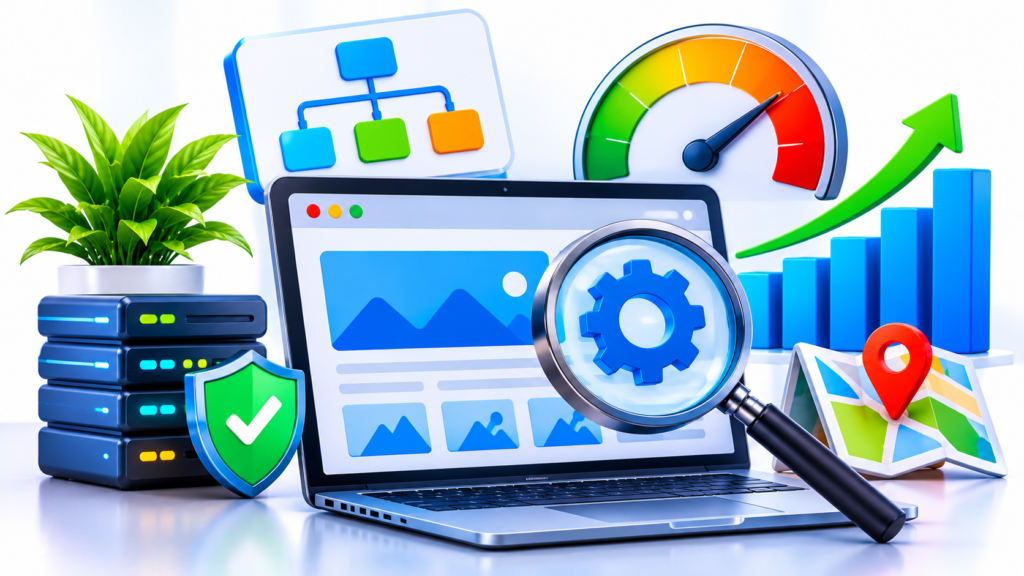
Technical SEO focuses on the infrastructure and technical configuration that help search engines access, process, and understand a website. Even high-quality content can struggle to achieve its full potential when important pages are blocked from crawling, load unreliably, or contain conflicting indexing instructions. A strong technical foundation begins with a logical website architecture, consistent URL management, reliable hosting, secure connections, and accessible navigation. Website owners should regularly examine server responses, redirect behaviour, internal links, robots.txt configuration, canonical tags, and sitemap accuracy. These elements help maintain a predictable relationship between users, website systems, and search engine crawlers. Technical SEO is not about adding unnecessary complexity; it is about removing barriers that prevent important information from being accessed correctly.
One important technical consideration is crawlability and indexability. Crawlability determines whether search engines can access website pages, while indexability concerns whether those pages are eligible to appear in search results. A robots.txt file can control crawler access to particular website paths, but it should not be used as a substitute for every indexing instruction. A page containing a noindex directive may be excluded from search results when the search engine can access and process that directive. Canonical tags can help communicate the preferred version of similar or duplicate URLs, especially when websites generate different URLs for filtering, tracking, or product variations. XML sitemaps should contain the canonical URLs that website owners want search engines to consider. Regular checks can identify accidental blocks, incorrect canonical references, redirect chains, and important pages that are missing from the intended site structure.
Website security and reliability are equally important components of technical SEO. HTTPS protects the connection between a website and its visitors by encrypting information transferred between them. Businesses should maintain valid SSL/TLS certificates, update website software, use trusted plugins, and apply appropriate security controls. Broken pages, repeated server errors, and unreliable hosting can negatively affect visitors and interfere with search engine access. Structured data can also help search engines interpret specific types of content, such as products, articles, organisations, and other supported entities. However, structured data must accurately represent visible page information and follow the relevant technical requirements. It does not guarantee rich results or higher rankings. Google’s technical SEO documentation offers guidance for website owners who want to review crawling, indexing, and technical accessibility. A regular technical audit helps businesses identify problems before they affect important landing pages and organic search performance.
High-Quality Content Creation and E-E-A-T Principles
High-quality content is central to sustainable SEO because search engines aim to provide information that genuinely helps users. Businesses should create pages that answer real questions, explain complex subjects accurately, and provide useful information that readers can apply. Content quality cannot be measured simply by word count. A long article may still be unhelpful if it repeats general statements without adding meaningful insights, while a shorter page may fully satisfy a specific search query. Effective content planning starts with audience research and a clear understanding of the problem each page is intended to solve. Writers should use relevant examples, explain important terminology, identify practical limitations, and provide appropriate next steps. Original research, first-hand experience, expert commentary, and carefully verified information can make a page more valuable than content that merely repeats what already exists elsewhere.
Google’s E-E-A-T framework stands for Experience, Expertise, Authoritativeness, and Trustworthiness. These concepts are used in Google’s Search Quality Rater Guidelines to help human evaluators assess aspects of content quality. Experience relates to whether content demonstrates relevant first-hand knowledge or practical involvement. Expertise concerns the knowledge and skills needed to explain a subject accurately. Authoritativeness relates to the reputation of the content creator, publisher, or organisation in a particular field. Trustworthiness focuses on the reliability, transparency, and accuracy of the information being presented. These concepts are particularly important when content covers subjects that can significantly affect people’s finances, health, safety, or other important decisions. However, E-E-A-T should not be treated as a simple score that website owners can increase by inserting author biographies or adding a badge to a page.
Businesses can strengthen content credibility through practical editorial standards. Articles should be reviewed for factual accuracy, supported by trustworthy references, and updated when important information changes. Authors should be presented honestly, with relevant professional backgrounds or experience where applicable. Websites should provide accessible contact information, clear business details, transparent policies, and appropriate information about who is responsible for published content. When discussing technical SEO recommendations, writers should link to official documentation rather than relying exclusively on unsupported claims or promotional sources. Google’s guidance on creating helpful, reliable, people-first content is a useful reference for evaluating whether a page genuinely serves its intended audience. Ultimately, content should be created for people first, with search optimisation supporting discoverability rather than replacing usefulness. This approach helps businesses develop trust, strengthen their reputation, and create resources that remain valuable beyond short-term ranking changes.
Off-Page SEO and Building Website Authority Through Quality Backlinks
Off-page SEO refers to activities performed outside a website that help strengthen its reputation, credibility, and visibility across the internet. Although off-page optimisation includes several activities, backlinks remain an important consideration in search engine optimisation. A backlink is a hyperlink from another website that directs visitors to your website. When relevant and trustworthy websites reference useful resources, these links can help search engines discover pages and understand relationships between different websites. However, not all backlinks provide equal value. A link from a respected industry publication that genuinely references an informative resource is generally more meaningful than hundreds of unrelated links created through automated submissions. Businesses should therefore prioritise relevance, editorial quality, and genuine relationships rather than focusing entirely on backlink quantities.
A sustainable link-building strategy begins with creating resources that other websites have a genuine reason to reference. These resources might include original research, detailed industry guides, useful statistics, practical tutorials, case studies, free tools, and informative reports. Businesses can promote these resources through professional outreach, industry partnerships, expert contributions, and relevant digital publications. For example, a website offering digital marketing services could publish an original study about website performance trends and share its findings with relevant marketing publications. If publishers find the information useful, they may reference the research and provide a natural backlink. This approach requires patience because publishers decide independently whether a resource deserves a reference. However, earning links through genuine usefulness creates a healthier long-term strategy than purchasing large quantities of artificial links.
Digital PR, brand mentions, professional networking, and industry participation can also support off-page SEO. Businesses can build relationships with journalists, bloggers, business associations, and relevant organisations by contributing accurate information and useful perspectives. Guest contributions can be valuable when they provide original insights to an established audience rather than existing solely to obtain backlinks. Similarly, social media distribution can increase content exposure and create opportunities for genuine references, although social engagement should not be treated as a direct ranking guarantee. Website owners must avoid link schemes, automated link generation, excessive reciprocal linking, and manipulative anchor-text campaigns. Google’s link spam policies explain practices that can violate search guidelines. The best off-page SEO strategy is built around reputation, meaningful relationships, and resources that deserve recognition.
Local SEO: Improving Visibility in Local Search Results
Local SEO focuses on improving a business’s visibility when people search for products or services in a particular geographic area. It is especially valuable for businesses that serve customers within specific cities, towns, neighbourhoods, or service regions. Examples include restaurants, repair companies, marketing agencies, medical practices, retail stores, construction businesses, and professional service providers. Local searches often contain geographic phrases such as “SEO agency near me”, “website designer in Karachi”, or “best digital marketing company in my area”. Search engines use information about relevance, distance, and prominence to help determine which local businesses appear for different searches. Businesses can improve their local search presence by maintaining accurate business information, creating useful location-specific pages, and developing a trustworthy online reputation.
One of the most important elements of local SEO is maintaining a complete and accurate Google Business Profile. Business owners should provide the correct business name, address, phone number, website, operating hours, service categories, and other relevant information. The profile should accurately represent the real business rather than containing promotional keywords added to the business name. High-quality photographs, appropriate service descriptions, and regular information updates can help potential customers understand what the business offers. Customer reviews also play an important role in the local decision-making process. Businesses should encourage genuine customer feedback and respond professionally to both positive and negative reviews. They must never purchase fake reviews, create misleading testimonials, or offer inappropriate incentives for positive ratings. Transparency and consistent customer service help develop a more credible local reputation.
Local landing pages and consistent business information across relevant directories can further strengthen a local SEO strategy. A business serving multiple locations may create individual pages when each location has genuinely distinct services, staff, facilities, or useful local information. However, creating dozens of nearly identical pages with only city names changed can result in low-value doorway content. Each location page should provide specific information that helps local customers make informed decisions. Businesses should also ensure that their name, address, and phone number remain accurate across reputable platforms where their information appears. Local keyword research can identify relevant service and geographic combinations, but these terms should be used naturally. Adding accurate LocalBusiness structured data where appropriate can help search engines understand business information. By combining a well-maintained business profile, genuine reviews, useful location pages, and accurate contact details, businesses can improve their opportunities to attract nearby customers.
Mobile SEO, Website Speed, and Core Web Vitals
Mobile SEO is the process of ensuring that a website provides an accessible, useful, and reliable experience on smartphones and other mobile devices. Mobile search has become an essential part of everyday internet usage, making responsive website design an important requirement for modern businesses. A website that looks attractive on a desktop computer may perform poorly on a smaller screen if its navigation is difficult to use, text is too small, buttons are too close together, or important information is hidden. Responsive design helps website layouts adapt to different screen sizes while maintaining consistent content and functionality. Businesses should test their websites on multiple devices and screen dimensions to identify layout problems, accessibility issues, and unnecessary interaction difficulties.
Website speed is another important part of the mobile experience. Slow-loading pages can frustrate visitors, increase abandonment, and make it harder for users to access important information. Several technical factors influence loading performance, including image sizes, server response times, JavaScript execution, CSS delivery, caching, and third-party scripts. Businesses can improve performance by compressing images, using modern image formats where supported, removing unnecessary plugins, reducing unused scripts, and selecting reliable hosting infrastructure. Browser caching and content delivery networks can also help deliver website resources more efficiently. However, speed optimisation should be approached carefully because removing scripts or modifying website code can sometimes break important functionality. Performance improvements should always be tested after implementation.
Google’s Core Web Vitals provide a framework for understanding important aspects of user experience. The main metrics are Largest Contentful Paint (LCP), Interaction to Next Paint (INP), and Cumulative Layout Shift (CLS). LCP measures loading performance by examining when the largest relevant content element becomes visible. INP evaluates responsiveness by measuring the delay associated with interactions throughout a page visit. CLS measures unexpected layout movement that can disrupt the visitor’s experience. Google identifies good target thresholds of 2.5 seconds or less for LCP, 200 milliseconds or less for INP, and 0.1 or less for CLS, generally assessed at the 75th percentile of page visits. Businesses can investigate these measurements through tools such as PageSpeed Insights, Lighthouse, and Google Search Console. Improving mobile usability and real-world performance helps create a more dependable website experience while supporting a stronger overall SEO foundation.
Website Architecture, URL Structure, and Internal Linking Strategy
Website architecture describes how information and pages are organised within a website. A clear structure helps visitors navigate content, understand relationships between topics, and locate important information without unnecessary effort. It also helps search engine crawlers discover pages and understand how different sections relate to one another. A logical architecture generally begins with the homepage, followed by primary category pages, supporting subcategories, and individual content pages. For example, a digital marketing website might organise its resources under categories such as SEO, content marketing, social media marketing, paid advertising, and website development. Each category can contain relevant guides and supporting articles. This organisation creates a meaningful information hierarchy and prevents valuable pages from becoming isolated or difficult to discover.
URL structure should support this architecture by providing readable and descriptive web addresses. A good URL is generally concise, understandable, and relevant to the page’s subject. For example, a URL such as /seo/technical-seo-guide/ communicates more information than a long address containing random parameters and unnecessary characters. Businesses should avoid changing established URLs without a clear reason because unnecessary changes can affect existing links, bookmarks, and search engine understanding. When a URL must change, an appropriate permanent redirect should be implemented to guide visitors and search engines to the correct replacement page. Website owners should also maintain consistent preferred URL formats, including decisions about trailing slashes, hostname versions, and HTTP versus HTTPS. Consistency helps prevent unnecessary URL variations and duplicate content issues.
Internal linking connects related pages within the same website and distributes navigational pathways throughout its content. It allows visitors to explore supporting information while helping crawlers discover additional pages. An effective internal linking strategy uses descriptive anchor text that accurately explains the destination. For example, an article about keyword research might link to a related guide about search intent analysis. Important service pages can also receive relevant links from educational articles where those links genuinely help readers understand available solutions. However, internal links should not be inserted simply to increase their quantity. Every link should have a clear purpose and lead to useful, relevant information. Businesses should regularly check for broken internal links, orphaned pages, unnecessary redirects, and important pages that are buried too deeply within the site structure. A well-organised website architecture improves usability, supports content discovery, and creates a stronger foundation for long-term organic growth.
Essential SEO Tools for Research, Optimisation, and Performance Monitoring
SEO tools help businesses understand website performance, investigate search opportunities, identify technical problems, and evaluate their competitors. Although tools cannot replace strategic thinking or high-quality content, they provide useful information for making better optimisation decisions. Google Search Console is one of the most important free resources for website owners. It provides information about search performance, indexing, page experience reports where available, and technical issues that may affect website visibility. Businesses can use its Performance report to examine clicks, impressions, average positions, and search queries. These insights help identify pages that already attract organic traffic, queries that generate visibility, and opportunities to improve existing content. Search Console can also help investigate indexing problems and monitor whether important website pages are being discovered and processed.
Google Analytics 4 provides additional insight into how visitors interact with a website. It can help businesses understand acquisition channels, user engagement, important events, and conversion-related activities. When configured correctly, Analytics can reveal which organic landing pages attract visitors and whether those visitors complete meaningful actions. For example, an SEO agency might track consultation form submissions, telephone clicks, and other relevant business enquiries. However, analytics information should be interpreted carefully. A high number of visitors does not automatically indicate successful marketing if the traffic is unrelated to the business or fails to generate useful outcomes. Tracking configurations should also respect applicable privacy requirements and provide accurate measurement without collecting unnecessary personal information.
Other SEO platforms provide additional research and auditing capabilities. Google Keyword Planner can help investigate keyword ideas and search demand. Google Trends can reveal changes in interest over time. PageSpeed Insights can evaluate website performance, while Lighthouse offers diagnostic information about performance, accessibility, and technical implementation. Commercial SEO platforms such as Ahrefs, Semrush, and Moz provide keyword research, backlink analysis, competitor research, and website auditing features, depending on their plans and available datasets. Businesses should choose tools based on their objectives, budget, website size, and technical requirements. It is rarely necessary to subscribe to every available platform. A practical SEO toolkit combines reliable first-party data, appropriate specialist tools, and human evaluation. Tools should help answer specific business questions rather than generate large reports that nobody uses to make improvements.
Measuring SEO Performance, Organic Traffic, and Return on Investment
Measuring SEO performance is essential because it helps businesses determine whether their optimisation activities are producing meaningful results. Without consistent measurement, it becomes difficult to identify successful strategies, diagnose declining performance, or decide where to invest additional resources. One of the most commonly monitored SEO indicators is organic traffic, which represents visits attributed to unpaid search engine results. However, traffic should never be considered the only measure of success. A website may attract thousands of visitors without generating enquiries, sales, or other valuable actions. Businesses should therefore establish measurable objectives before implementing their SEO strategies. These objectives might include increasing qualified organic traffic, improving visibility for relevant commercial keywords, generating more consultation requests, or increasing online purchases.
Several key performance indicators can help evaluate organic search performance. Organic clicks indicate how many users visit a website through unpaid search results, while impressions show how frequently pages appear for relevant searches. Click-through rate measures the percentage of impressions that result in clicks. Average position provides an approximate indication of where a website appears for recorded queries, although it varies according to search context and should not be interpreted as a fixed universal ranking. Conversion rate measures the percentage of visitors who complete a desired action. Other useful indicators include engaged sessions, qualified leads, revenue from organic traffic, landing page performance, and the number of indexed pages where relevant. Monitoring these metrics together creates a more complete understanding of SEO effectiveness.
Return on investment is particularly important for businesses that allocate significant budgets to SEO. A practical evaluation should consider the revenue or business value generated through organic search compared with the cost of research, content production, technical improvements, tools, and professional services. For example, a service business might calculate the value of qualified enquiries generated through organic landing pages and compare it with its monthly SEO investment. However, attribution can be complex because customers often interact with multiple channels before making a purchase. SEO may introduce a visitor who later returns through direct traffic, email, or paid advertising. Businesses should therefore use consistent measurement methods and avoid assuming that every conversion can be attributed to a single interaction. Regular reporting, realistic timelines, and meaningful business objectives allow organisations to evaluate performance more accurately and make informed optimisation decisions.
Common SEO Mistakes That Reduce Website Visibility and Organic Growth
One of the most common SEO mistakes is keyword stuffing. This occurs when website owners repeatedly insert target keywords into paragraphs, headings, titles, or metadata in an unnatural attempt to influence search rankings. Such practices reduce readability and can make content appear manipulative rather than helpful. Another frequent mistake is publishing large quantities of low-quality articles without researching audience needs. Businesses sometimes create multiple pages targeting nearly identical keywords, hoping that more content will automatically produce more traffic. In reality, pages that provide little original information or repeat existing material may offer limited value. A better strategy is to research each topic carefully, identify its search intent, and create content that provides a clear and useful answer. Existing pages should also be reviewed regularly to identify opportunities for improvement, consolidation, or removal when appropriate.
Technical mistakes can also limit organic performance. Common examples include accidentally blocking important pages through robots.txt, applying incorrect noindex directives, using inconsistent canonical tags, leaving broken internal links, and creating unnecessary redirect chains. Some websites also have poor mobile experiences, oversized images, slow hosting, or unstable page layouts. These problems can affect usability and make it harder for search engines to access and understand important information. Another mistake is changing URLs without implementing appropriate redirects, which can disrupt established navigation paths and external links. Businesses should perform technical audits periodically and test significant website changes before deploying them. A carefully maintained technical foundation reduces avoidable problems and allows high-quality content to be discovered more reliably.
Manipulative off-page practices create additional risks. Buying large quantities of backlinks, participating in link exchanges designed to manipulate rankings, publishing automated comments, and using private link networks can violate search engine spam policies. Businesses may also damage their credibility through fake reviews, misleading claims, copied content, and inaccurate business information. Another mistake is expecting immediate results from SEO. Organic search performance usually requires consistent effort, particularly in competitive industries where established websites already have strong content and reputations. Businesses should avoid making major strategic decisions based on short-term ranking fluctuations alone. Instead, they should monitor meaningful performance trends, improve content quality, resolve technical issues, and build genuine industry relationships. Avoiding these mistakes creates a more reliable SEO strategy that supports both website visitors and long-term business objectives.
SEO Best Practices Summary for Sustainable Search Visibility and Business Growth
Successful SEO depends on combining useful content, sound technical implementation, and a clear understanding of audience needs. Businesses should begin by researching relevant keywords and understanding the search intent behind them. Every important website page should have a clearly defined purpose, an appropriate content format, and a logical relationship with other pages. Content should answer genuine questions, explain important topics accurately, and provide practical value rather than repeating keywords for search engines. Page titles, headings, URLs, images, and internal links should be optimised naturally. Websites should also provide clear navigation, readable layouts, accessible content, and a consistent experience across desktop and mobile devices. These practices help create a website that is easier to understand and more useful for visitors.
Technical maintenance should remain part of every ongoing SEO programme. Businesses should monitor crawling and indexing, maintain accurate XML sitemaps, review canonical configurations, use secure HTTPS connections, and resolve broken pages. Website performance should be measured through appropriate tools, including PageSpeed Insights and Google Search Console. Core Web Vitals should be reviewed alongside accessibility, mobile usability, and functional reliability. Structured data can be implemented where relevant, provided it accurately represents the visible page content and follows search engine requirements. Businesses should also maintain appropriate security controls, update their website platforms, and back up important information. Technical optimisation is most effective when it supports genuine user needs instead of introducing unnecessary complexity.
Off-page optimisation should focus on building a credible reputation through valuable resources, relevant partnerships, and natural editorial references. Businesses should earn backlinks through useful research, original insights, expert contributions, and professional relationships. Local businesses should maintain accurate business profiles, respond professionally to reviews, and create meaningful location-specific content where appropriate. Performance measurement should include organic traffic, qualified enquiries, conversions, revenue, and other indicators connected to business goals. SEO strategies should be reviewed regularly because search behaviour, competition, and technology continue to evolve. Most importantly, businesses should follow Google’s published search policies and avoid manipulative shortcuts. Consistent improvement, honest communication, helpful content, and a reliable technical foundation provide the strongest basis for sustainable organic search visibility and long-term online growth.
Frequently Asked Questions
1. What is SEO, and why is it important for businesses?
SEO, or Search Engine Optimisation, is the process of improving a website’s visibility in unpaid search engine results. It helps search engines discover and understand website pages while making those pages more relevant and useful to visitors. SEO is important because potential customers frequently use search engines to research products, compare services, and find solutions to specific problems. A properly optimised website can attract relevant visitors without requiring payment for every individual click. It can also support brand awareness, establish industry credibility, and generate enquiries or sales. Unlike some short-term advertising campaigns, well-maintained organic content may continue attracting visitors over an extended period. However, SEO requires consistent investment, monitoring, and improvement to remain competitive.
2. How long does SEO take to produce results?
SEO does not have a fixed timeline because results depend on several factors, including website history, competition, content quality, technical condition, industry demand, and the resources invested in optimisation. A recently launched website may need time to establish visibility, while an established website with strong content may see improvements sooner after addressing specific problems. Technical corrections can sometimes produce relatively quick changes in crawling or indexing, but competitive keyword rankings and meaningful business growth often require sustained work. Businesses should avoid agencies or consultants that guarantee specific rankings within unrealistic periods. A sensible approach involves establishing a performance baseline, implementing improvements, monitoring search visibility, and evaluating results over several months.
3. What is the difference between on-page SEO and off-page SEO?
On-page SEO involves optimising elements within a website, including content, headings, page titles, images, URLs, and internal links. Its purpose is to make individual pages more understandable, relevant, and useful for visitors and search engines. Off-page SEO involves activities outside the website that help develop reputation and credibility. Examples include earning backlinks from relevant publications, building professional relationships, participating in industry discussions, and gaining legitimate brand mentions. Both areas contribute to a broader SEO strategy. Strong on-page optimisation ensures that website pages provide valuable information, while responsible off-page activities help build recognition and trust. Neither approach should rely on manipulative tactics or artificial ranking schemes.
4. How do I choose the right keywords for my website?
Choosing the right keywords requires understanding your target audience, products, services, and the questions potential customers ask. Start by identifying the main subjects that relate directly to your business. Use keyword research platforms to investigate relevant search phrases, related queries, estimated search demand, and competition. Then examine search results to understand what users expect when searching for those terms. Consider whether the keyword has informational, navigational, commercial, or transactional intent. A business should prioritise keywords that attract relevant visitors and support its actual objectives rather than targeting high-volume phrases simply because they appear popular. Organising related keywords into topic groups also helps create a more logical website structure and reduces unnecessary content duplication.
5. Are backlinks still important for SEO?
Backlinks remain a relevant part of SEO because they can help search engines discover pages and understand references between websites. However, their value depends on context, relevance, and the way they are acquired. A natural editorial link from a relevant and reputable publication can provide meaningful exposure and referral traffic. Artificial links created through automated services, purchased link schemes, or unrelated websites may create risks rather than sustainable benefits. Businesses should focus on publishing resources that other websites genuinely want to reference. Original research, practical guides, useful tools, and expert contributions can create legitimate link opportunities. The objective should be building a trustworthy online reputation, not collecting the largest possible number of backlinks.
6. What are the best free tools for improving SEO?
Several free tools can help businesses manage important SEO activities. Google Search Console provides search performance information, indexing reports, and technical insights. Google Analytics 4 helps analyse visitor behaviour, acquisition channels, and conversions. Google Keyword Planner can support keyword research, while Google Trends helps investigate changes in search interest. PageSpeed Insights evaluates website performance and provides optimisation recommendations. Lighthouse can also help examine performance, accessibility, and technical quality. These tools provide useful information, but their results should be interpreted carefully. No tool can independently create an effective SEO strategy. Businesses still need to understand their audiences, evaluate search intent, create useful content, and implement appropriate technical improvements.
7. Does publishing more blog posts automatically improve search rankings?
Publishing more blog posts does not automatically improve search rankings. Content quality, relevance, usefulness, and search intent are more important than publishing frequency alone. A website with a smaller collection of detailed, accurate, and valuable resources may perform better than a website containing hundreds of repetitive articles. Businesses should develop an editorial plan based on audience needs and relevant keyword opportunities. Each article should address a clear topic, provide meaningful information, and connect logically with other relevant website pages. Existing content should also be updated when facts change or better information becomes available. Publishing consistently can support topical coverage, but quantity should never replace quality.
8. Can small businesses compete with larger companies through SEO?
Small businesses can compete with larger organisations by focusing on relevant audiences, specialised topics, local search opportunities, and high-quality content. Large companies may have greater budgets and stronger existing brand recognition, but smaller businesses can often provide more focused information and specialised services. For example, a local website development company may target specific services and geographic areas rather than competing immediately for extremely broad national keywords. Creating detailed service pages, answering customer questions, maintaining an accurate Google Business Profile, and collecting genuine reviews can help establish local visibility. Small businesses should also identify underserved topics and demonstrate practical expertise. A focused strategy with realistic goals can create valuable organic opportunities even in competitive industries.
Final SEO Action Plan: Turning Strategy Into Practical Results
Understanding SEO is only the beginning. Sustainable improvements happen when businesses convert knowledge into a structured implementation process. Rather than attempting to change every part of a website simultaneously, organisations should identify their most important opportunities and prioritise work according to potential impact, technical difficulty, and available resources.
The following action plan provides a practical starting point for implementing the strategies discussed throughout this guide.
Step 1: Evaluate your current website.
Start with a complete website review. Examine the website’s navigation, page structure, content quality, mobile usability, security, and loading performance. Identify pages that attract organic traffic and those that have indexing or technical problems. Establish a baseline before making significant changes so that future performance can be compared accurately.
Step 2: Research your target keywords.
Identify relevant search terms based on your products, services, and audience questions. Investigate search intent, competition, and keyword relevance. Organise related terms into topic groups and assign them to appropriate website pages.
Step 3: Improve existing website content.
Review important landing pages and articles. Improve outdated information, clarify explanations, add useful examples, and strengthen page structure. Ensure that every important page serves a clear purpose and provides value beyond what visitors can easily find elsewhere.
Step 4: Resolve technical SEO problems.
Review crawlability, indexability, redirects, canonical tags, XML sitemaps, broken links, and HTTPS configuration. Check mobile usability and Core Web Vitals. Test technical changes carefully before applying them across the entire website.
Step 5: Strengthen internal and external links.
Connect relevant pages through descriptive internal links. Develop valuable resources that industry publications and other relevant websites may want to reference. Avoid artificial link-building schemes and prioritise genuine relationships.
Step 6: Improve local and mobile visibility.
If your business serves specific locations, maintain an accurate Google Business Profile and publish useful local information. Ensure that your website works properly across different devices and provides a convenient experience for mobile visitors.
Step 7: Monitor results and improve continuously.
Use Google Search Console and Google Analytics 4 to monitor organic search performance, user engagement, and conversions. Review results regularly and identify which improvements produce meaningful business outcomes. Update your strategy as search behaviour and customer needs change.
Want to Implement This Easily?
AI Implementation Prompt
You are an expert SEO consultant. Based on the blog post titled “SEO: The Complete Guide to Search Engine Optimisation, Organic Traffic, Rankings, and Sustainable Online Growth”, provide a step-by-step, practical implementation guide.
Include the following:
- A complete SEO audit checklist for an existing website.
- A keyword research strategy with primary, secondary, and long-tail keyword opportunities.
- A search intent analysis and content planning framework.
- On-page SEO optimisation techniques for titles, meta descriptions, headings, URLs, images, and internal links.
- A technical SEO implementation checklist covering crawling, indexing, sitemaps, canonical tags, HTTPS, redirects, and website performance.
- A content strategy based on Google E-E-A-T principles and helpful, people-first content.
- An ethical backlink acquisition and off-page SEO strategy.
- Local SEO recommendations for businesses targeting specific geographic locations.
- Recommended SEO tools, including free and paid options.
- A practical measurement framework covering organic traffic, keyword visibility, conversions, and return on investment.
- Common SEO mistakes to avoid and advanced optimisation recommendations.
- A realistic 30-day, 60-day, and 90-day SEO implementation roadmap.
Assume the reader wants to implement everything discussed in this article effectively. Make the recommendations practical, prioritised, easy to understand, and suitable for businesses of different sizes. Do not guarantee search rankings or traffic results. Follow Google’s official search documentation and spam policies.
Call to Action
Want our help implementing this? Just reach out to us via our website contact form: