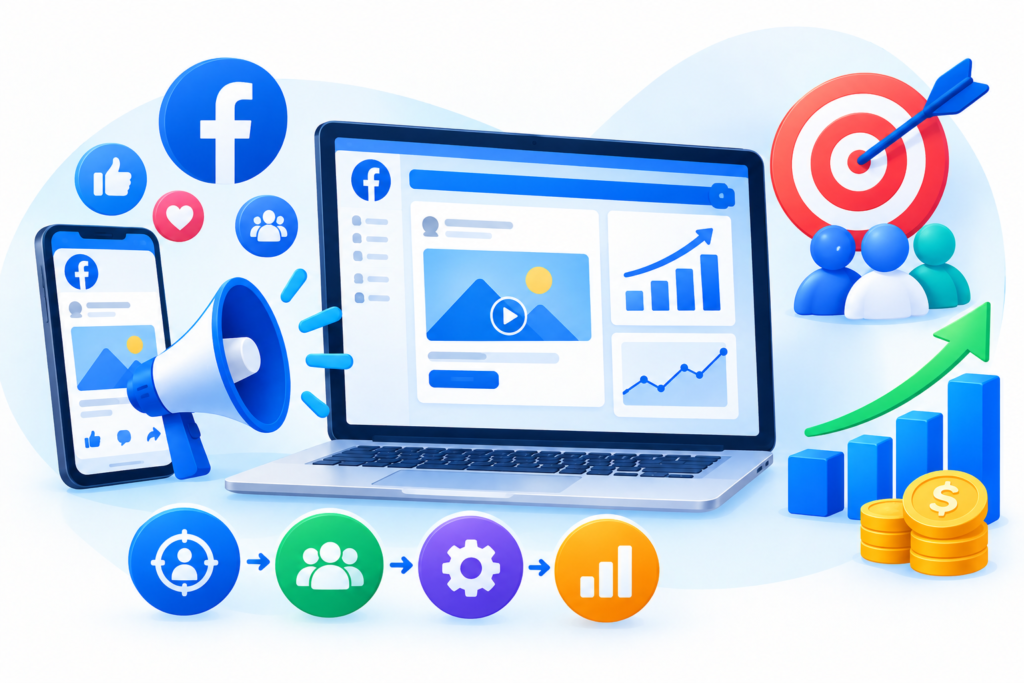
Learn how to create high-performing Facebook Ads campaigns with effective targeting, compelling creative, conversion tracking, budgeting, testing, retargeting, and practical optimization strategies.
Introduction
Facebook Ads can be one of the most effective ways for businesses to reach potential customers, generate qualified leads, increase online sales, and build awareness around products and services. However, successful advertising requires much more than creating an attractive image and selecting a target audience. High-performing campaigns are built around a clear objective, strong customer research, relevant messaging, persuasive creative, accurate measurement, and continuous optimization.
For businesses using Facebook Ads, the difference between wasted advertising spend and sustainable growth often comes down to strategy. A campaign can receive thousands of impressions and hundreds of clicks without producing meaningful revenue. At the same time, a smaller campaign with a carefully selected audience, relevant offer, and strong customer journey can generate significantly better results.
This guide explains how to approach Facebook advertising from a strategic and practical perspective. It covers campaign planning, audience research, objectives, ad creative, copywriting, landing pages, budgets, tracking, testing, retargeting, optimization, scaling, common mistakes, and best practices. The goal is not to promise a particular result but to provide a framework that businesses can adapt to their market, offer, audience, and available resources.
For businesses publishing supporting marketing content, Google’s people-first content guidance emphasizes creating useful, original, reliable information for people rather than content designed primarily to manipulate search rankings. This same principle is valuable in advertising: the strongest campaigns focus on genuine customer needs instead of relying on exaggerated claims or short-term tactics.
MyBlogPoster can use Facebook advertising as part of a broader digital marketing strategy, but paid traffic should always connect with a meaningful business objective. Advertising works best when the audience, offer, creative, landing page, sales process, and measurement system support one another.
Understanding How Facebook Ads Work
Facebook Ads are paid promotional placements that allow businesses to present products, services, offers, content, applications, and other messages to selected audiences across Meta’s advertising environment. Advertisers can define campaign objectives, audiences, budgets, placements, creative assets, and conversion events while using performance data to evaluate the results.
One of the most important concepts to understand is that advertising activity and business results are not the same thing. An advertisement may generate impressions without producing attention, clicks without producing meaningful visits, leads without producing qualified prospects, or purchases without producing enough profit. Therefore, advertisers need to understand the entire customer journey rather than evaluating a campaign using one attractive metric.
Facebook advertising operates through an auction-based delivery system. Advertisers compete for opportunities to show their advertisements to relevant users, while delivery can be influenced by factors such as the campaign objective, audience, predicted action, available inventory, creative quality, and other platform signals. This means there is no universal Facebook Ads cost that applies to every business or industry.
For example, a local business targeting a limited geographic area may experience very different advertising economics from an international ecommerce company. A highly competitive industry may also face different costs from a niche market with less advertising competition. Seasonal demand, audience availability, creative fatigue, and customer purchasing behavior can also influence performance.
The most useful way to think about Facebook advertising is therefore as a customer acquisition system rather than simply a collection of advertisements. The advertisement creates attention, the message creates interest, the landing page supports the decision, the offer creates motivation, and the conversion process turns interest into measurable business value.
This approach also prevents advertisers from chasing vanity metrics. A campaign with a lower cost per click is not automatically better than a campaign with a higher cost per click. If the second campaign generates more qualified leads or profitable customers, it may be considerably more valuable.
The first question before launching any campaign should therefore be:
What specific business result should this advertising generate?
Once that question has a clear answer, the rest of the campaign becomes much easier to design.
Setting Clear Goals for a Facebook Advertising Campaign
Every successful Facebook advertising campaign should begin with a clearly defined goal. Without a specific objective, advertisers can easily become distracted by surface-level metrics such as impressions, reactions, video views, or clicks. These numbers can provide useful information, but they do not automatically indicate whether the business is moving closer to its commercial objective.
A campaign goal should describe the action that matters most to the business. An ecommerce company may want to increase purchases. A professional service provider may want qualified leads. A local company may want appointment requests or phone inquiries. A software business may want product registrations or demonstrations. A content-driven brand may initially want to build awareness and engagement.
The goal should also be connected to a realistic measurement framework. Google advertising documentation similarly recommends identifying specific advertising goals and determining how success will be measured. Its guidance explains that campaigns designed for sales or conversions should place greater emphasis on conversion information and relevant landing pages.
This principle is useful even when Facebook Ads are the primary advertising channel. Before spending money, determine:
- What action represents success?
- What is an acceptable cost for that action?
- What happens after the conversion?
- How valuable is a new customer?
- How quickly does the business recover acquisition costs?
- Which metrics indicate genuine progress?
For example, suppose a campaign generates 200 leads. That number may initially appear impressive. However, if only five leads are genuinely qualified and none become customers, the campaign may be weaker than another campaign that generates 50 leads and produces ten customers.
This is why lead quality matters more than lead volume.
Businesses should also distinguish between short-term and long-term goals. A new company may initially need awareness and audience development before expecting large numbers of direct purchases. A mature company may already have sufficient awareness and therefore prioritize conversion campaigns.
Goals should not be changed simply because the initial results are disappointing. Instead, investigate why the campaign is underperforming. The problem could involve audience relevance, creative quality, offer positioning, landing-page experience, conversion tracking, or the sales process.
A well-defined goal gives every later decision a purpose. It determines what creative should emphasize, which audience should be prioritized, which conversion event should be measured, and which performance indicators should influence optimization.
Researching and Defining the Right Facebook Ads Audience
Audience research is one of the most important foundations of Facebook advertising. Even an excellent advertisement can perform poorly when it is shown to people who do not need the product, cannot afford it, are located outside the service area, or are not currently interested in solving the problem.
Traditional audience research often starts with demographic characteristics such as age, gender, location, and occupation. These details can be useful, but they are only part of the picture. Strong audience research also examines problems, motivations, objections, desires, purchasing behavior, and awareness level.
Start by identifying the customer problem. What is the person trying to accomplish? What frustrates them? What alternatives have they already tried? What prevents them from taking action? What result would make the purchase worthwhile?
Customer reviews can provide valuable information here. So can sales calls, support conversations, surveys, website analytics, CRM records, previous campaigns, and competitor research. These sources often reveal the exact language customers use when describing their problems.
That language can become extremely useful in advertising.
For example, a business selling accounting software may discover that customers are not primarily searching for “advanced financial management.” Instead, they may be frustrated by spending hours manually organizing invoices. The stronger advertising message would therefore focus on reducing manual work rather than simply listing software features.
Audience research should also consider customer awareness.
A person who has never heard of the business needs a different message from someone who has already visited the website. A person who has viewed a product page may need reassurance, proof, or an answer to an objection. A previous customer may need a complementary offer rather than another introductory advertisement.
This makes audience segmentation useful when it improves relevance.
However, excessive segmentation can also create problems. Splitting a campaign into many tiny audiences may limit the amount of data available for optimization. Advertisers should therefore avoid creating complicated structures simply because they appear sophisticated.
The best audience is not necessarily the largest audience or the smallest audience.
The best audience is the audience that provides enough potential customers while maintaining meaningful relevance and sustainable economics.
Choosing the Right Facebook Ads Campaign Objective
Selecting the appropriate campaign objective is an important strategic decision because the objective tells the advertising system what type of result the campaign is intended to pursue. If the business wants purchases but designs the campaign around an unrelated outcome, the resulting traffic may not have the characteristics needed for profitable customer acquisition.
Campaign objectives should therefore reflect the actual business goal, not the easiest metric to obtain.
Awareness-focused campaigns can be useful when a business needs to introduce itself to a new market or increase recognition. Consideration-focused strategies can support activities such as website visits, content engagement, or lead development. Conversion-focused campaigns are more appropriate when the business is ready to optimize toward valuable actions such as purchases or qualified inquiries.
The correct choice depends on the business model and customer journey.
For example, a high-value service may involve several stages before a customer becomes ready to buy. In that situation, immediately asking every new prospect for a purchase may be less effective than providing educational content or an initial consultation. An impulse-purchase product, on the other hand, may have a much shorter customer journey.
A useful framework is:
Awareness → Interest → Evaluation → Conversion → Retention
Not every business needs a separate campaign for every stage. The framework simply helps marketers understand that customers can have different levels of intent.
Campaign objectives should also be connected to conversion measurement. A conversion should represent something meaningful to the business. Google describes conversion goals as actions that advertisers consider valuable and recommends organizing conversion actions around meaningful business objectives.
Although the platforms differ, the underlying marketing principle is universal: optimize toward actions that matter.
Avoid selecting an objective merely because it produces inexpensive results. Cheap traffic can be completely unprofitable if visitors do not become customers.
Before selecting an objective, ask:
- What do I ultimately want the customer to do?
- Is that action measurable?
- Is enough data available to optimize toward it?
- Does the landing page support the action?
- Can the sales team or ecommerce system process the resulting customers?
- Can the business determine whether those customers are profitable?
Answering these questions creates a stronger foundation for campaign development.
Creating Facebook Ad Creative That Captures Attention

Creative is often the first part of a Facebook advertisement that a potential customer notices. Images, videos, product demonstrations, graphics, headlines, primary text, and visual composition all influence whether a person stops scrolling and pays attention.
However, effective creative is not simply about making something beautiful.
The most valuable creative communicates relevance quickly.
A person should be able to understand what the advertisement is about and why it may matter to them without needing to study it for an extended period. This is particularly important in mobile environments where users are exposed to large amounts of competing content.
A strong creative concept usually focuses on one central message.
For example:
- Demonstrate how a product solves a problem.
- Show the before-and-after experience.
- Explain a common mistake.
- Present a customer result.
- Highlight a specific product benefit.
- Demonstrate a service process.
- Answer a common objection.
- Introduce a compelling offer.
Trying to communicate every benefit in one advertisement can make the message difficult to understand.
Creative variety is also important. Instead of producing ten advertisements that look almost identical, create different creative angles. One advertisement could use a demonstration, another could use a testimonial, another could focus on a problem, and another could emphasize convenience.
This creates more useful learning.
Video can be particularly effective when it communicates the core idea quickly. Vertical, mobile-oriented creative can be useful for placements designed around full-screen viewing. Meta’s advertising resources emphasize mobile-oriented creative considerations for Reels placements, including vertical formats and attention to the positioning of important creative elements.
More generally, advertisers should ensure that text, product demonstrations, branding, and calls to action remain visually understandable on smaller screens.
Creative should also match the brand and audience. A professional B2B company may require a different presentation style from a consumer lifestyle brand. Authenticity can sometimes outperform highly polished production when the audience responds better to real demonstrations or human experiences.
The ultimate objective is not to create the most attractive advertisement.
It is to create the advertisement that communicates the right message to the right person strongly enough to encourage the intended next step.
Writing Facebook Ad Copy That Persuades Without Overpromising
Facebook ad copy should help the audience understand the problem, recognize the relevance of the solution, and decide whether taking the next step is worthwhile. Good copy does not need to be complicated. In many cases, clear and specific language is more effective than excessive promotional wording.
A useful structure is to begin with a relevant problem or situation. The opening should give the intended customer a reason to continue reading. The copy can then explain the benefit, introduce the solution, provide supporting evidence, address an important objection, and finish with an appropriate call to action.
The exact structure can change depending on the advertisement.
For example, a product demonstration may require very little copy because the video explains the concept. A complex professional service may require more context. A limited promotional offer may focus heavily on the offer itself.
The most important rule is message clarity.
Avoid vague phrases such as “Take your business to the next level” unless the advertisement explains exactly what that means. Instead, communicate the specific value being offered.
Specificity builds understanding.
If a service helps businesses improve their website performance, explain what aspect of performance is being addressed. If a product saves time, explain what task becomes easier. If an offer reduces a customer’s cost, clearly explain the conditions that apply.
Advertising should also avoid misleading claims. Promising guaranteed results when results depend on many external factors can damage trust and potentially create compliance issues. Honest messaging is usually more sustainable than aggressive promises.
Different customer motivations can also be tested.
One advertisement may emphasize time savings.
Another may focus on cost efficiency.
Another may focus on simplicity.
Another may emphasize confidence or risk reduction.
Another may use social proof.
These variations can reveal what matters most to the audience.
Calls to action should match the user’s stage. “Learn More” may be appropriate for someone beginning their research, while “Buy Now,” “Book a Consultation,” or “Request a Quote” may make more sense for someone with stronger purchase intent.
Strong copy does not pressure everyone.
It helps the right customer recognize that the offer is relevant.
Building a Landing Page That Converts Facebook Traffic
The advertisement is only one part of the customer journey. Once a person clicks, the landing page becomes responsible for continuing the experience. If the advertisement is compelling but the landing page is confusing, slow, irrelevant, or difficult to use, advertising performance can suffer significantly.
The first principle is message continuity.
If the advertisement promotes a particular product, service, discount, guide, or benefit, the landing page should immediately confirm that the visitor has arrived at the expected destination. A major disconnect between the advertisement and landing page creates uncertainty.
For example, imagine an advertisement promising a specific service package. The visitor clicks and arrives on a generic homepage containing dozens of unrelated services. The visitor now has to search for the offer they expected. Every additional step creates friction.
A dedicated landing page can often make the journey clearer.
The page should communicate:
- What is being offered.
- Who the offer is for.
- Why it matters.
- What benefits the customer receives.
- What action should be taken.
- Why the business can be trusted.
- What questions or objections the customer may have.
The page should also work properly on mobile devices. Google’s page experience guidance recommends considering Core Web Vitals, secure delivery, mobile usability, intrusive interstitials, and the overall experience provided to visitors.
Page speed matters because advertising traffic is often impatient. If a visitor clicks an advertisement and waits too long for the page to become usable, some of the advertising investment has effectively been wasted.
Trust signals can also improve decision-making. Depending on the business, these may include customer testimonials, reviews, recognizable certifications, transparent pricing, clear contact information, product demonstrations, guarantees where appropriate, case studies, or other legitimate evidence.
The call to action should be obvious.
If the objective is lead generation, the form should be easy to understand. If the objective is purchasing, the buying process should be straightforward. If the objective is booking a consultation, the scheduling experience should not require unnecessary steps.
Finally, do not assume that a weak conversion rate automatically means the Facebook advertisement is bad.
The problem could be the landing page, offer, price, trust level, page speed, form, messaging, or sales process.
The entire funnel must be evaluated before deciding where the real problem exists.
Setting a Facebook Ads Budget and Managing Advertising Spend
A successful Facebook Ads campaign needs a budget that matches the campaign objective, audience size, conversion potential, and testing requirements. Setting a budget is not simply a matter of choosing an amount that feels affordable. Businesses should understand how much they can reasonably spend to acquire a customer, generate a qualified lead, or produce another valuable action. A useful starting point is to determine the expected value of a conversion and then establish an acceptable acquisition cost. For example, an online store selling a $150 product may be able to spend considerably more to acquire a customer than a business selling a $20 product. The same principle applies to lead generation, where the value of a qualified lead depends on the percentage of leads that eventually become paying customers. A campaign budget should therefore be connected to business economics rather than vanity metrics such as impressions or likes.
Facebook Ads budgeting can be approached through daily or campaign-level spending controls depending on the campaign setup and advertising strategy. During the testing stage, businesses should avoid spreading a limited budget across too many audiences, placements, and creative variations at once. Excessive fragmentation makes it difficult to collect enough meaningful data from each variation. A more practical approach is to identify the most important variables and test them systematically. For example, an advertiser might test two audience groups and several creative concepts while keeping the offer and landing page relatively consistent. Once sufficient data indicates which combinations produce valuable results, more budget can be directed toward the stronger performers. This creates a disciplined process in which spending supports learning before aggressive scaling begins.
Budget management should also account for fluctuations in performance. Facebook advertising results can change because of competition, seasonality, audience behavior, creative fatigue, changes in the offer, website performance, or changes in conversion rates. A campaign that performs well for several days should not automatically receive a dramatic budget increase without considering whether the additional traffic can maintain acceptable economics. Likewise, a campaign should not be stopped immediately because of a short period of weak performance if there is insufficient data to determine whether the problem is temporary. The best approach is to establish clear decision thresholds before launching. Businesses should define what constitutes an acceptable cost per result, what signals require investigation, and what circumstances justify scaling, reducing, or pausing spend.
Understanding Facebook Ads Metrics and Measuring Real Performance
Facebook Ads produces a large amount of performance data, but not every metric deserves equal attention. Impressions, reach, clicks, click-through rate, cost per click, engagement, conversions, conversion rate, cost per acquisition, and return on advertising spend can each provide useful information. The important question is how those metrics connect to the actual business objective. If the campaign goal is lead generation, a high number of clicks does not necessarily indicate success if visitors fail to complete the form. If the goal is ecommerce sales, strong engagement does not compensate for poor purchase volume or an unacceptable acquisition cost. Measurement should therefore move beyond surface-level engagement and focus on meaningful outcomes.
A useful way to interpret Facebook Ads data is to examine the campaign as a funnel. Reach and impressions indicate whether the advertising system is delivering the message to the intended audience. Click-through rate can provide clues about how effectively the creative and offer generate interest. Landing-page behavior can reveal whether the transition from advertisement to website is working. Conversion rate then shows how efficiently the traffic produces the desired action. Finally, cost per acquisition and revenue-related metrics help determine whether the campaign makes financial sense. Looking at these stages together is more useful than judging a campaign using a single metric. For example, a low click-through rate may indicate a creative problem, while a high click-through rate combined with a low conversion rate may indicate a landing-page, offer, trust, or audience problem.
Businesses should also distinguish between reporting metrics and decision-making metrics. Reporting metrics describe what happened, while decision-making metrics help determine what should happen next. A dashboard might contain dozens of measurements, but the campaign manager should identify a smaller group of indicators that directly relate to the campaign objective. Google Ads guidance similarly emphasizes identifying specific advertising goals and measuring performance against those goals rather than treating every available metric as equally important. The same principle is valuable when evaluating Facebook Ads: measure what matters to the business, investigate the reasons behind weak results, and make changes based on evidence rather than assumptions.
Implementing Conversion Tracking and Data Measurement Correctly
Conversion tracking is one of the most important components of performance advertising because it connects advertising activity with meaningful customer actions. Without reliable measurement, an advertiser may know that people are clicking advertisements without knowing whether those visitors are becoming leads, customers, subscribers, or other valuable users. Proper tracking helps create a clearer connection between advertising spend and business outcomes. Before launching a campaign, businesses should define exactly what counts as a conversion. Depending on the business model, this might include a completed purchase, submitted lead form, phone inquiry, registration, booking request, or another commercially valuable action.
Tracking should be designed around the customer journey rather than isolated events. Consider a business that generates leads through a landing page. A user might first view an advertisement, click through to the landing page, read the offer, submit a form, receive a confirmation page, and eventually become a customer. If measurement only records the initial click, the business has no reliable way to understand which advertising activity is generating actual commercial value. A stronger measurement system connects the advertising interaction to downstream actions wherever technically and legally appropriate. Conversion goals are similarly important in Google Ads because they organize meaningful actions and allow primary conversion actions to contribute to optimization.
Advertisers should also regularly audit their measurement setup. Duplicate conversions, missing events, incorrect attribution, broken tracking after website changes, and poorly defined conversion actions can lead to misleading conclusions. A campaign may appear profitable because several actions are being counted multiple times, or it may appear ineffective because the most important conversion is not being recorded correctly. Tracking should therefore be tested before significant budget is committed and checked again after major website, checkout, form, or analytics changes. Data quality is not a one-time technical task. It is an ongoing part of campaign management and should be treated as a core component of responsible Facebook advertising.
Using Retargeting to Reconnect With Interested Audiences
Retargeting allows advertisers to communicate with people who have already interacted with a business, website, product, content asset, or previous advertisement. These audiences can be valuable because they have demonstrated some level of interest. A visitor who viewed a product page but did not purchase, for example, may require more information, reassurance, a stronger offer, or simply additional time before making a decision. Retargeting can provide a second opportunity to address those needs. Instead of treating every website visitor as a completely new prospect, businesses can create messaging that reflects the person’s previous interaction with the brand.
Effective retargeting should not simply repeat the original advertisement. Someone who already visited a product page may need a different message from someone who only watched a short video. Similarly, a person who added a product to a shopping cart may deserve a more direct reminder than someone who visited the homepage once. Audience segmentation allows advertisers to match the message with the level of demonstrated intent. Common segments can include recent website visitors, product viewers, previous customers, people who interacted with social content, and users who began but did not complete an important action. Each segment can receive different creative, offers, and messaging.
Retargeting also requires frequency and audience management. Showing the same advertisement repeatedly can create fatigue and may damage the user experience. Advertisers should monitor frequency, creative performance, conversion behavior, and audience size to determine whether the retargeting campaign remains useful. Exclusion audiences are equally important. Someone who has already purchased a product may not need to continue seeing advertisements designed to convince them to make their first purchase. Instead, that customer could be moved into a retention, cross-selling, upselling, or repeat-purchase strategy. When structured properly, retargeting becomes more than a reminder system; it becomes a way of aligning advertising messages with different stages of the customer journey.
Testing Facebook Ads and Finding Winning Creative Combinations
Testing is essential because assumptions about what customers will respond to are often unreliable. An advertiser may believe that a polished product image will outperform a simple demonstration video, while the audience may respond more strongly to the video. Another business may assume that a discount will produce the most conversions but discover that a clear explanation of product benefits performs better. Testing allows these assumptions to be replaced with evidence. The purpose of testing is not to change everything simultaneously but to isolate important variables and understand which combinations contribute to better results.
Creative testing can involve several variables, including the opening hook, visual format, headline, primary text, offer, call to action, product presentation, testimonial, demonstration, and emotional angle. A structured test might compare an educational creative with a product-focused creative while keeping the audience, offer, and landing page consistent. Another test could compare two different hooks using the same core message. This approach makes the results easier to interpret. If an advertiser changes the audience, creative, offer, landing page, and budget at the same time, it becomes difficult to determine which change actually caused the performance difference.
Testing should also continue after a winning advertisement is identified. A strong creative can eventually experience fatigue as the same audience sees it repeatedly. Instead of waiting until performance collapses, advertisers can build a creative development system that continually introduces new concepts. New variations should retain the core lessons learned from successful campaigns while exploring different presentations. This creates a cycle of learning: test, analyze, identify the strongest ideas, develop variations, and test again. Over time, the advertiser builds a library of proven creative angles rather than relying on one advertisement indefinitely.
Scaling Successful Facebook Ads Without Destroying Performance
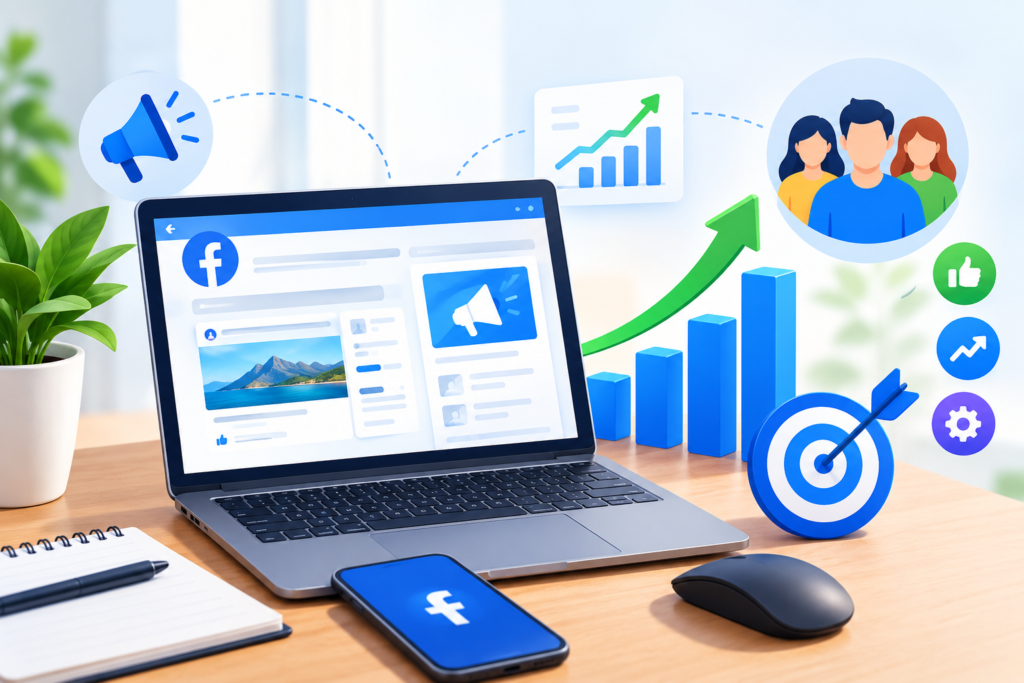
Scaling Facebook Ads requires a balance between increasing advertising volume and preserving efficiency. A campaign that produces excellent results at a modest spend may not maintain exactly the same performance when the budget increases significantly. This can happen because the advertising system begins reaching additional people with lower predicted conversion potential, competition changes, or the audience becomes saturated. Scaling should therefore be treated as a controlled process rather than a single large budget increase.
One approach is to scale gradually while monitoring the metrics that matter most to the business. If the campaign continues to produce acceptable conversion volume and acquisition costs, additional budget may be justified. However, advertisers should examine performance over an appropriate period rather than reacting to individual hours or isolated results. Significant changes can temporarily affect campaign behavior, and short-term volatility does not necessarily indicate a permanent problem. The advertiser’s objective should be to determine whether the campaign can sustainably generate additional valuable conversions at acceptable economics.
Creative scalability is equally important. Increasing budget without increasing creative variety can cause audience fatigue. Successful scaling therefore often involves expanding the creative system alongside the media budget. Advertisers can create new versions based on proven hooks, objections, demonstrations, testimonials, product benefits, and customer problems. They can also test additional audience opportunities where appropriate. Sustainable scaling comes from building a repeatable acquisition system rather than depending on one audience, one advertisement, or one short-term promotional idea.
Common Mistakes When Running Facebook Ads
One of the most common Facebook Ads mistakes is launching campaigns without a clearly defined business objective. Businesses sometimes begin with a vague goal such as “get more exposure” or “increase engagement” without determining what action should ultimately create value. This makes it difficult to choose the right campaign structure, landing page, conversion event, and performance metric. A campaign should have a clearly defined purpose before money is invested. Whether that purpose is sales, qualified leads, registrations, bookings, or another measurable outcome, the objective should be connected to the broader customer journey.
Another frequent mistake is focusing too heavily on clicks and engagement while ignoring conversion quality. A campaign can produce inexpensive traffic that generates very little revenue. High engagement can also create a false impression of success when users are interested in the content but have no intention of purchasing. Advertisers should investigate what happens after the click. If people click but do not convert, the issue may involve the landing page, offer, trust signals, pricing, page speed, checkout process, audience quality, or mismatch between the advertisement and the destination. Google’s page experience guidance emphasizes factors such as good Core Web Vitals, mobile usability, secure pages, and keeping important content accessible without disruptive experiences.
A third mistake is changing too many variables without a clear testing framework. Constantly editing campaigns can make it difficult to understand what caused improvement or decline. Other problems include targeting audiences that are too narrow, using repetitive creative, failing to exclude existing customers when appropriate, ignoring conversion tracking, and increasing budgets too aggressively. Businesses should also avoid making decisions from insufficient data. A responsible campaign manager creates a clear process for testing, measurement, evaluation, and optimization. This creates more stable learning and reduces the temptation to make emotional decisions based on isolated results.
Best Practices Summary for a Sustainable Facebook Ads Strategy
A sustainable Facebook Ads strategy begins with the customer rather than the advertising platform. Understand who the customer is, what problem they are trying to solve, what objections may prevent action, and what information they need before making a decision. Build advertisements around useful and persuasive communication instead of simply trying to generate impressions. Strong campaigns connect audience research, creative strategy, offers, landing pages, conversion tracking, and follow-up into one coherent customer journey.
Campaign measurement should remain closely connected to commercial outcomes. Define meaningful conversions, verify that tracking works correctly, and establish performance benchmarks before making major changes. Use campaign data to identify where the funnel is losing potential customers. A weak result at one stage does not necessarily mean the entire campaign is unsuccessful. Low engagement may point toward creative problems, strong clicks with poor conversions may indicate landing-page or offer problems, and acceptable conversion rates with poor economics may require pricing, acquisition-cost, or customer-value analysis.
Finally, sustainable Facebook advertising requires continuous learning. Test new creative concepts, document successful patterns, refresh advertisements before fatigue becomes severe, and scale carefully. Advertising platforms and user behavior evolve, so strategies that work today should not be treated as permanent formulas. Businesses should continually evaluate performance and improve the underlying customer experience. This people-first approach is consistent with Google’s broader guidance that successful digital content should provide original, useful, reliable information rather than being created primarily to manipulate search rankings.
Frequently Asked Questions
What are Facebook Ads?
Facebook Ads are paid advertisements distributed through Meta’s advertising ecosystem to reach selected audiences with commercial, informational, promotional, or conversion-focused messages. Advertisers can use different campaign approaches depending on whether they want to generate awareness, traffic, leads, sales, or other measurable outcomes.
How much should a business spend on Facebook Ads?
There is no universal budget that works for every business. The appropriate amount depends on the value of a customer or lead, expected conversion rate, competition, audience size, sales cycle, and acceptable acquisition cost. A sensible approach is to begin with a controlled testing budget and increase spending when the campaign demonstrates reliable performance.
What makes a Facebook Ad effective?
Effective advertisements usually combine a relevant audience, clear value proposition, strong creative, concise messaging, an appropriate offer, and a logical next step. The advertisement should also accurately reflect what users will find after clicking.
How long should Facebook Ads run before being evaluated?
There is no single timeframe that applies to every campaign. Evaluation should consider conversion volume, spending level, sales cycle, audience size, and the amount of reliable data available. Very small campaigns may require more time before meaningful conclusions can be drawn.
Why are my Facebook Ads getting clicks but no sales?
Clicks without sales can indicate a mismatch between the advertisement and landing page, weak offer, poor user experience, insufficient trust, incorrect audience targeting, technical problems, or weak conversion tracking. Reviewing the complete funnel is more useful than simply changing the advertisement.
Should businesses use video for Facebook Ads?
Video can be highly effective when it communicates a product, demonstration, customer problem, story, or benefit quickly. However, there is no rule that every campaign must use video. The strongest format depends on the audience, message, product, and creative concept.
What is retargeting in Facebook Ads?
Retargeting involves advertising to people who have previously interacted with a business or its digital properties. It can help reconnect with users who showed interest but did not complete the desired action.
How can Facebook Ads be scaled safely?
Start by identifying campaigns that consistently meet the required performance standard. Increase investment carefully, monitor acquisition costs and conversion quality, and maintain a steady pipeline of new creative concepts. Scaling should increase useful conversion volume without sacrificing the economics that made the campaign successful.
Conclusion
Facebook Ads can become a powerful customer-acquisition channel when advertising decisions are based on clear objectives, strong audience understanding, persuasive creative, accurate measurement, and continuous testing. The strongest campaigns are not built around one clever advertisement. They are built around a connected system that moves the right audience from awareness to consideration and eventually toward a valuable action.
Businesses should begin by defining the result they actually want, identifying the audience most likely to produce that result, and creating advertisements that communicate a relevant benefit clearly. From there, the landing page and conversion experience must support the promise made in the advertisement. Reliable tracking allows advertisers to understand what is working, while structured testing helps identify stronger creative and messaging combinations.
Long-term success also depends on disciplined budget management and ongoing optimization. Avoid judging campaigns only by clicks or engagement. Look at the quality and commercial value of the results. Continue developing new creative concepts, use retargeting thoughtfully, and scale campaigns gradually. With this approach, Facebook advertising can become a repeatable part of a broader digital growth strategy rather than a collection of isolated promotional campaigns.
For businesses that want to turn these principles into a practical advertising process, MyBlogPoster can be used as the starting point for exploring implementation support and related digital marketing solutions.
Want to Implement This Easily?
You are an expert consultant. Based on the blog post titled “Facebook Ads”, provide a step-by-step, practical implementation guide. Include tools, best practices, common mistakes to avoid, and advanced tips. Assume the reader wants to implement everything discussed in this article effectively.
Want our help implementing this? Just reach out to us via our contact form.