
Learn SEO from the fundamentals to advanced strategies, including keyword research, search intent, technical SEO, on-page optimization, content strategy, internal linking, authority, and sustainable organic growth.
Introduction
Search Engine Optimization (SEO) is one of the most important disciplines for businesses that want to build sustainable visibility through organic search. Unlike advertising, where visibility generally depends on continuing investment, SEO focuses on improving a website’s ability to be discovered, understood, trusted, and used by people searching for relevant information, products, or services.
Modern SEO is much broader than adding keywords to webpages. It combines technical website performance, information architecture, content quality, search intent, internal linking, user experience, authority, structured information, and continuous measurement. A strong SEO strategy considers the complete relationship between what users search for, what a website provides, and how search engines interpret that information.
Google’s official SEO Starter Guide explains fundamental practices that can help search engines crawl, understand, and index website content. Google’s Search Essentials also outlines the fundamental requirements and spam policies that websites should follow when appearing in Google Search.
For businesses, SEO can support more than rankings. A well-optimized website can attract relevant visitors, answer customer questions, build brand visibility, generate leads, support sales, and establish long-term topical authority. The most valuable SEO strategy is therefore not necessarily the one that produces the largest number of visitors. It is the strategy that attracts the right visitors and gives them a useful reason to stay, trust the information, and take the next appropriate action.
This complete guide explains how to build an SEO strategy from the ground up. It covers keyword research, search intent, technical SEO, on-page optimization, content quality, website architecture, internal links, authority, page experience, local search, ecommerce, analytics, AI-powered search, common mistakes, and practical best practices.
For MyBlogPoster, the objective should be to build an organic search presence based on useful information, clear website structure, trustworthy content, and sustainable optimization rather than short-term manipulation.
Understanding SEO and Why It Matters for Long-Term Digital Growth
SEO refers to the process of improving a website and its content so search engines can better discover, interpret, and present relevant information to users. The discipline includes technical optimization, content development, website architecture, keyword research, internal linking, user experience, authority development, and performance analysis.
The importance of SEO comes from the way people use search engines to solve problems. Someone may search for a service, research a product, compare alternatives, investigate a problem, or learn how to accomplish a task. Each search represents a potential opportunity for a website to provide a useful answer. The website that best satisfies the user’s need can create a meaningful relationship with that visitor.
However, SEO should not be viewed as a guaranteed ranking formula. Search results are influenced by many systems and signals, and there is no universal optimization technique that guarantees a first position. Google itself states in its SEO Starter Guide that there are no secrets that automatically rank a website first.
This makes the foundation of SEO particularly important. Instead of chasing every algorithm rumor, website owners should concentrate on creating helpful content, maintaining accessible technical infrastructure, organizing information logically, improving user experience, and understanding the needs of their audience.
Long-term SEO can also create compounding value. A detailed guide can attract visitors for months or years, support related service pages, earn references, answer customer questions, generate internal links, and establish topical relevance. The same article can serve users at different stages of the buying journey when it is structured appropriately.
The objective is therefore not simply more traffic. The objective is relevant visibility that contributes to meaningful outcomes.
Developing an SEO Strategy Based on Business Objectives and Search Demand
A strong SEO strategy begins with business objectives. Before creating keyword lists or publishing articles, identify what organic search needs to accomplish. A business may want more qualified leads, ecommerce sales, local customers, newsletter subscribers, product discovery, brand awareness, or educational visibility.
Once the objective is clear, define the audience. Different groups can search for the same solution using completely different language. A beginner might search for “what is SEO,” while an experienced professional could search for “technical SEO crawling problems.” Both searches relate to SEO, but they require different content.
Keyword research should therefore be connected to user needs rather than treated as an isolated activity. Build topic groups around problems, questions, services, products, and commercial needs. These groups can then become content clusters containing cornerstone pages and supporting resources.
Search intent is another critical component. Informational queries generally require educational resources. Commercial investigation searches may require comparisons, service explanations, case studies, or buyer guides. Transactional queries often require product or service pages. Navigational queries usually involve finding a specific website, organization, or resource.
The strongest SEO strategy creates a relationship between business objectives, audience needs, search demand, search intent, content format, and conversion opportunities.
This also prevents businesses from wasting resources on irrelevant keywords. A keyword may have thousands of searches but little commercial relevance to the business. Another phrase may have significantly lower search volume but represent a highly qualified potential customer.
SEO strategy should therefore prioritize relevance and usefulness over vanity metrics.
Performing Keyword Research and Building Search Intent Clusters
Keyword research helps identify the language people use when searching for information, products, services, and solutions. Effective keyword research does not simply produce a list of phrases. It provides insight into the questions, problems, expectations, and motivations behind those searches.
Search intent can generally be grouped into informational, navigational, commercial investigation, and transactional categories. Informational searches seek knowledge. Navigational searches seek a particular destination. Commercial searches investigate options before making a decision. Transactional searches indicate stronger action-oriented intent.
Understanding intent determines what kind of page should be created. A query asking “how to improve website speed” may be best served by a practical tutorial. A search for “SEO services” may require a service page. A query for “best SEO tools” may require a comparison or research article.
Keyword clustering makes this process more efficient. Closely related phrases can often be covered within one comprehensive resource rather than creating separate pages for every minor variation. Supporting pages can then address distinct subtopics that deserve their own treatment.
For example, an SEO content hub might contain a primary SEO guide supported by separate pages covering keyword research, technical SEO, internal linking, local SEO, ecommerce SEO, structured data, SEO analytics, and content optimization.
Semantic relevance should also be considered. A high-quality technical SEO page may naturally discuss crawling, indexing, redirects, canonical URLs, XML sitemaps, robots directives, JavaScript rendering, and status codes without repeating the same keyword excessively.
Avoid keyword stuffing. Keywords should help clarify the topic, not make the writing unnatural. Search engines increasingly understand context and relationships between concepts, making natural language and comprehensive coverage more useful than artificial repetition.
Creating High-Quality Content That Demonstrates Experience and Expertise
High-quality content is central to sustainable SEO because search engines are designed to help users find useful information. Publishing content solely because a keyword has search volume can produce pages that technically target queries but fail to satisfy users.
Strong content starts with a clear purpose. Before writing, determine who the page is for, what problem it solves, what information the reader needs, and what evidence or experience can make the resource more useful.
Experience can be particularly valuable. First-hand examples, implementation lessons, original observations, practical workflows, case studies, testing results, screenshots, and real-world scenarios can differentiate content from generic summaries.
Expertise does not mean filling a page with complicated terminology. A knowledgeable writer should be able to explain complex subjects clearly, distinguish facts from assumptions, describe limitations, and identify circumstances where different approaches may be appropriate.
Google’s guidance on Creating Helpful, Reliable, People-First Content encourages content that provides original information, substantial value, and a satisfying experience for readers.
Trustworthiness is equally important. Content should avoid unsupported claims, misleading statements, fabricated statistics, and exaggerated guarantees. Where important claims depend on external evidence, credible references should be used.
A strong article should leave readers feeling that they understand the subject better than they did before reading it.
The goal is not to write content that merely looks optimized. The goal is to produce information that deserves to be discovered.
Optimizing Website Architecture, URLs, Navigation, and Internal Links

Website architecture determines how information is organized and how users and search engines move between pages. A clear architecture makes important content easier to discover and helps establish logical relationships between topics.
Navigation should be intuitive. Users should be able to identify major sections without excessive effort. Important pages should not be buried under unnecessary levels of navigation.
Internal linking is another major component of website structure. Relevant internal links help visitors discover related resources while providing additional context about relationships between pages.
For example, an introductory SEO article could link naturally to keyword research, technical SEO, on-page SEO, and SEO analytics resources. A service page could link to case studies, FAQs, supporting guides, and related services.
Google’s Search Essentials and SEO documentation provide guidance on crawlable links and descriptive link text. Anchor text should clearly communicate what users can expect after clicking.
URLs should also be descriptive and stable. A clear URL can help visitors understand the destination before clicking. Avoid unnecessary complexity, meaningless parameters, and frequent URL changes.
Website architecture should ultimately support the user journey. Someone who discovers an informational article should be able to move naturally toward deeper education, evaluation, and action.
A well-organized website creates an ecosystem rather than a collection of disconnected pages.
Implementing Technical SEO for Crawling, Indexing, and Search Accessibility
Technical SEO establishes the foundation that allows search engines to access and understand website content. Even excellent content can struggle if important pages are inaccessible, accidentally excluded from indexing, or affected by technical problems.
Technical SEO includes areas such as crawling, indexing, robots directives, XML sitemaps, canonical URLs, redirects, HTTP status codes, JavaScript rendering, duplicate URLs, mobile accessibility, and website architecture.
Crawling allows search engines to discover and request resources. Indexing involves processing and storing information about pages that may later appear in search results.
An important technical SEO audit should identify whether valuable pages can be crawled and indexed correctly. It should also identify unnecessary pages that may consume resources or create duplication.
Google’s Search Essentials provides fundamental technical requirements and spam policies for websites appearing in Search.
Technical SEO should not become a checklist exercise where every automated warning is treated as equally important. Prioritize problems that affect valuable pages, users, crawling, indexing, security, or website functionality.
Common technical problems include accidental noindex directives, broken internal links, incorrect canonical tags, redirect chains, server errors, blocked resources, duplicate URLs, and poorly implemented JavaScript.
Technical SEO should also be included in website development and redesign projects from the beginning. Fixing problems after launch is often more difficult than preventing them during development.
Building Strong On-Page SEO and Search-Friendly Page Elements
On-page SEO involves improving the elements of individual pages so their purpose and information are clear to users and search engines.
Page titles should accurately communicate the main subject. Headings should create a logical hierarchy. The introduction should establish the topic quickly. Body content should answer the user’s questions in an organized and readable way.
Formatting can improve usability. Descriptive subheadings, concise paragraphs, examples, lists, tables, images, and appropriate visual elements can make complex information easier to navigate.
Images should be relevant and appropriately optimized. Where an image communicates meaningful information, useful alternative text can help describe its purpose.
Internal links should provide additional context rather than simply increasing the number of links on a page.
Metadata should also accurately describe the page. Search engines may generate their own snippets, so the quality of the actual page remains more important than attempting to control every search-result presentation.
The SEO Starter Guide emphasizes useful content, logical organization, readable text, and descriptive page elements.
On-page SEO is therefore not about placing keywords into every possible location. It is about making the page clear, relevant, useful, and easy to understand.
A well-optimized page should make sense to a visitor even if the visitor never thinks about SEO.
Strengthening Authority, Trust, and Natural Link Earning
A successful SEO strategy is not built only around keywords, technical optimization, or publishing frequency. Search visibility also depends on whether a website provides information that users can reasonably trust and whether other relevant websites naturally recognize its value. Authority develops over time through useful resources, accurate information, original insights, transparent communication, and a consistent experience across the website. Businesses should therefore approach authority building as a long-term process rather than attempting to manufacture rankings through artificial link schemes or low-quality promotional tactics.
One of the strongest ways to build authority is to create resources that genuinely deserve to be referenced. Original research, detailed guides, practical tutorials, industry explanations, case studies, calculators, templates, statistics, and expert commentary can provide reasons for publishers to mention a website. Instead of asking how many backlinks a page can obtain, businesses should ask whether the page offers something sufficiently useful that another website would voluntarily reference it. This change in perspective makes link building more closely connected with content quality, public relations, digital publishing, and expertise. It also reduces dependence on tactics that may create short-term signals without establishing lasting value.
Trust should also be visible on the website itself. Clear author information, accurate business details, contact information, editorial standards, references where appropriate, transparent policies, and clearly explained claims can improve the credibility of important pages. For websites operating in specialized industries, content should be reviewed by people with relevant knowledge rather than being produced solely to target search queries. A page that demonstrates genuine experience and explains its subject clearly gives visitors stronger reasons to remain engaged, return later, and recommend the resource. Over time, these behaviors can support a healthier organic growth model in which useful content, brand recognition, relationships, and naturally earned references reinforce one another.
Improving Page Experience, Core Web Vitals, Mobile Usability, and Performance
Technical quality and user experience are important components of modern SEO optimization. A website can contain excellent information, but visitors may struggle to use it if pages load slowly, layouts shift unexpectedly, navigation is confusing, or mobile users must repeatedly zoom and scroll. Page experience should therefore be considered during website development rather than treated as a final SEO task. Businesses should evaluate how quickly pages become useful, how stable the visual layout remains, how responsive interactions feel, and whether users can comfortably complete the actions they came to perform.
Core Web Vitals provide useful performance measurements around loading performance, responsiveness, and visual stability. These measurements can help developers identify technical issues that affect real-world user experiences. However, performance should not be reduced to chasing individual scores. A fast page that provides poor information, confusing navigation, or an unusable conversion process is still a poor experience. Businesses should combine technical measurement with practical testing across different devices, browsers, connection conditions, and user journeys. The objective is not simply to obtain a technical score but to create a website that feels reliable and responsive to real visitors.
Mobile optimization deserves particular attention because many searches occur on smartphones and other small-screen devices. Responsive layouts, readable typography, accessible navigation, appropriately sized interactive elements, optimized images, efficient scripts, and simple forms can make mobile experiences significantly easier to use. Businesses should also avoid unnecessary pop-ups and intrusive elements that interrupt users before they can access the main content. Performance improvements should be prioritized according to their effect on real users and important business journeys. A useful process is to identify the slowest templates, examine their causes, make targeted improvements, and then monitor the results rather than repeatedly making unstructured technical changes.
Using Local SEO to Increase Visibility for Location-Based Searches
For businesses serving particular cities, regions, neighborhoods, or physical locations, local SEO can connect organic search visibility with customers who have immediate geographic intent. Someone searching for a service near their location is often looking for practical information such as availability, opening hours, service areas, directions, contact details, pricing information, or evidence that the business actually serves their area. Local optimization should therefore provide accurate and useful information rather than simply repeating city names throughout a website.
A strong local strategy begins with consistent business information. The business name, address, telephone number, website details, opening hours, and service information should be maintained accurately wherever the business manages its presence. Location-specific website pages can also be valuable when they contain genuinely useful information about the services provided in that area. However, creating dozens of nearly identical city pages with only place names changed can produce weak experiences. Each location page should have a meaningful purpose and should help visitors understand what the business actually offers in that market.
Local content can become considerably stronger when it demonstrates real involvement in the communities being served. Businesses can publish location-specific guides, explain service availability, answer regional questions, highlight projects, describe local considerations, or provide practical information relevant to customers in those areas. Reviews and customer feedback can also contribute to credibility when collected and presented according to applicable platform policies. The central principle remains simple: local SEO should help searchers understand where a business operates, what it offers, and why the information is relevant to their location. Geographic relevance becomes much more meaningful when it is supported by genuinely useful local information.
Applying SEO to Ecommerce Websites and Product Pages
Ecommerce SEO requires a combination of technical architecture, product optimization, category strategy, useful content, and a smooth purchasing experience. Online stores can contain thousands of URLs, making crawl efficiency and information architecture particularly important. Categories should have clear relationships with products, filters should be handled carefully, and unnecessary URL variations should not overwhelm search engines with duplicate or low-value pages. A well-organized ecommerce structure makes it easier for users to discover products while also helping search engines understand how the website is organized.
Individual product pages should provide information that helps customers make purchasing decisions. Product names, descriptions, specifications, compatibility information, dimensions, materials, images, availability, shipping information, and relevant customer questions can all contribute to a more useful page. Descriptions should be written specifically for the business rather than copied directly from manufacturers when possible. Original product photography, demonstrations, comparisons, usage guidance, and practical explanations can further differentiate an ecommerce website from competitors selling similar products. Keyword optimization should support this information rather than replacing it with repetitive search phrases.
Category pages also deserve strategic attention because they can target broader commercial search intent. Instead of treating categories as simple collections of product links, businesses can use them to explain selection criteria, product differences, common use cases, and purchasing considerations. Internal links can connect category pages with related guides and individual products, creating a logical path from informational research to commercial evaluation and purchase. Ecommerce SEO should ultimately be measured not only by impressions and rankings but also by qualified traffic, product engagement, conversion rates, revenue, and customer value. Visibility matters most when it contributes to a useful buying journey.
Measuring SEO Performance with Search Console, Analytics, and Business Data
SEO becomes significantly more effective when decisions are based on evidence rather than assumptions. Businesses should establish a measurement framework that connects search visibility with meaningful outcomes. Search Console can help website owners understand how their pages perform in Google Search, while analytics platforms can provide additional information about user behavior and conversions. Together, these sources can reveal whether organic visibility is expanding, which pages attract searchers, which queries generate impressions, and where users continue or leave the conversion journey.
Important SEO metrics should be selected according to business objectives. Impressions can show whether a website is appearing for relevant searches, while clicks provide information about traffic generated from search results. Click-through rate can help identify opportunities where pages receive substantial impressions but comparatively few clicks. Average search position can provide directional information, but it should not be treated as a complete representation of organic performance. Conversion rate, qualified leads, revenue, engagement, and customer acquisition value are often more meaningful when evaluating commercial SEO. A page that generates fewer visits but significantly more qualified leads may be more valuable than a page receiving large volumes of irrelevant traffic.
Measurement should also be connected to specific SEO activities. If a business publishes a new content cluster, improves internal linking, changes page titles, or resolves technical problems, it should establish a reasonable observation period and monitor relevant outcomes. SEO data should be interpreted carefully because rankings and search demand naturally fluctuate. Seasonality, market changes, algorithm updates, competitor activity, technical incidents, and changes in search behavior can all influence results. A mature reporting system therefore focuses on patterns rather than reacting emotionally to individual daily movements. Regular monthly or quarterly reviews can help teams identify what is working, what requires investigation, and where resources should be invested next.
Preparing Content for AI-Powered Search Experiences
Search is increasingly capable of providing users with synthesized answers, summaries, recommendations, and expanded result experiences. This creates new considerations for SEO content strategy. Businesses should not attempt to write exclusively for an imagined AI system. Instead, they should continue creating clear, original, trustworthy information that can be understood and referenced within different search experiences. Strong fundamentals such as accurate information, useful structure, original perspectives, clear terminology, and genuine expertise remain valuable as search interfaces evolve.
Content should answer important questions directly while providing enough context to make the information useful. Clear headings, concise explanations, supporting evidence, definitions, examples, and logical organization make information easier for both people and automated systems to understand. At the same time, businesses should avoid producing large quantities of repetitive pages simply because AI tools make content generation easier. Automated production does not automatically create value. If many pages provide substantially the same information with minor wording changes, the website may become harder to maintain and less useful to visitors.
Organizations should also develop information that cannot easily be replaced by generic summaries. First-hand experiences, original research, proprietary data, detailed case studies, expert interviews, product demonstrations, unique processes, and genuine customer insights can create stronger differentiation. Businesses should review existing content regularly to identify outdated claims and update important resources when circumstances change. The objective is not to predict exactly how every future search interface will operate. A more durable approach is to build a website that consistently demonstrates usefulness, expertise, transparency, and original value regardless of how users discover the information.
Common SEO Mistakes and How to Avoid Them
One of the most common SEO mistakes is focusing too heavily on individual keywords while ignoring search intent. A page may include the exact phrase a person searches for but still fail to satisfy that person’s needs. Before creating or optimizing a page, businesses should determine what users are actually trying to accomplish. Informational, commercial, transactional, navigational, and local searches can require very different content formats. Matching the page to the underlying purpose of the query is often more useful than repeatedly inserting a keyword into headings and paragraphs.
Another frequent mistake is publishing large amounts of low-value content without a clear editorial strategy. More pages do not automatically mean more organic visibility. Content should have a defined purpose, a target audience, and sufficient depth to answer the questions it addresses. Businesses should also avoid copying competitors, producing near-duplicate location pages, hiding excessive keywords in text, manipulating links, or creating content primarily to exploit search-engine signals. These approaches can consume significant resources while failing to establish a sustainable organic presence.
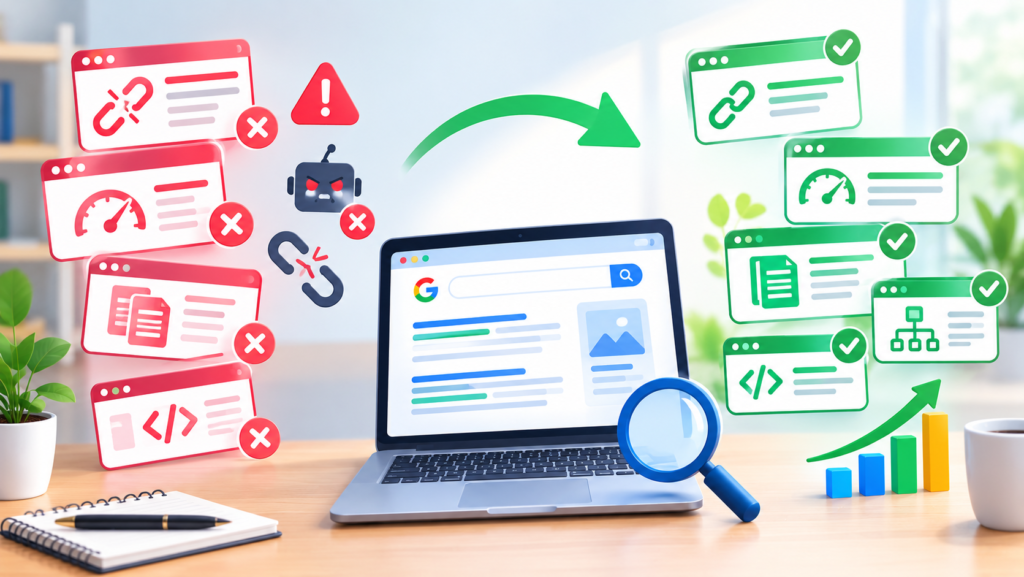
Technical neglect is another major problem. Broken internal links, incorrect canonicalization, accidental noindex directives, poor redirects, duplicate URLs, inaccessible content, slow templates, and mobile usability problems can all interfere with organic performance. The solution is not to perform every technical SEO task at once. Instead, businesses should establish a regular technical review process, prioritize issues by impact, and document changes. The strongest SEO programs combine technical maintenance with useful content and clear business objectives. SEO should be treated as an ongoing operating discipline rather than a one-time optimization project.
Best Practices Summary, FAQs, and Long-Term SEO Implementation
A sustainable SEO strategy should be built around several connected principles rather than one isolated tactic. Businesses should begin with clear objectives and understand the audiences they want to reach. They should research search demand and intent before creating content, organize websites around logical information architecture, and make important pages easy to crawl and understand. Content should demonstrate genuine usefulness, experience, expertise, and accuracy. Technical SEO should support accessibility and performance, while internal linking should help users discover related information naturally.
Best Practices Summary
- Define measurable SEO and business objectives before choosing tactics.
- Research search intent rather than focusing exclusively on keyword volume.
- Build content around genuine audience needs and meaningful topics.
- Create original information, examples, research, and practical guidance where possible.
- Maintain a logical website structure with descriptive navigation and URLs.
- Use internal links to connect related pages and support useful user journeys.
- Monitor crawling, indexing, redirects, canonicalization, and technical errors.
- Optimize page titles, headings, descriptions, images, and other on-page elements naturally.
- Improve mobile usability and page performance.
- Monitor Core Web Vitals without treating individual scores as the entire SEO strategy.
- Build authority through useful resources and genuine relationships rather than artificial links.
- Keep business and local information accurate.
- Optimize ecommerce categories and product pages around real purchasing needs.
- Measure organic performance using search, engagement, conversion, and business data.
- Review important content regularly and update information when necessary.
- Avoid keyword stuffing, deceptive tactics, scaled low-value content, and manipulative link practices.
- Treat SEO as a long-term process requiring testing, measurement, maintenance, and refinement.
Frequently Asked Questions
1. What is SEO?
SEO, or search engine optimization, is the process of improving a website so that search engines can understand its content and users can discover useful pages through relevant searches. It includes content, technical accessibility, website structure, internal linking, page experience, and other practices that help a website provide a strong search experience. Effective SEO focuses on both search visibility and the usefulness of the resulting visitor experience.
2. How long does SEO take to produce results?
There is no universal timeframe because results depend on factors such as website history, competition, content quality, technical condition, search demand, authority, resources, and the changes being implemented. Some technical improvements may produce relatively quick improvements in crawling or usability, while competitive content topics can require considerably more time. SEO should therefore be managed through measurable milestones rather than a fixed promise of rankings within a particular number of days.
3. Is keyword research still important?
Yes, keyword research can help businesses understand the language people use when searching and identify topics, questions, and commercial needs. However, modern SEO should not treat keywords as phrases that must be inserted repeatedly. Search intent, context, topic coverage, user expectations, and content usefulness are equally important. A strong keyword strategy identifies opportunities and then uses those insights to create genuinely helpful resources.
4. Does publishing more content automatically improve SEO?
No. Publishing frequency by itself does not guarantee improved organic visibility. A smaller collection of highly useful resources can provide more value than a large library of repetitive or shallow pages. Businesses should prioritize content quality, relevance, originality, accuracy, and usefulness. Before publishing another article, it is worth asking whether the page provides something genuinely valuable that the existing website does not already provide.
5. Are backlinks important for SEO?
Links can help search engines discover pages and can also indicate relationships or references between websites. However, businesses should focus on earning relevant references through useful content, original research, expertise, partnerships, and resources that publishers genuinely want to mention. Purchasing or manipulating links purely to influence rankings can create risks. The most sustainable approach is to create assets that naturally deserve attention.
6. Do Core Web Vitals guarantee better rankings?
No. Good performance is an important part of providing a positive experience, but technical performance alone does not guarantee high search rankings. A successful page also needs useful information, relevance, accessibility, appropriate search intent alignment, and other quality characteristics. Businesses should treat Core Web Vitals as part of a broader website-quality and user-experience program.
7. Should businesses use AI for SEO content?
AI tools can assist with research, brainstorming, outlining, editing, classification, and other workflow tasks. However, businesses remain responsible for the accuracy, originality, usefulness, and quality of published content. Content should not be produced at scale merely because automation makes it possible. Human review, subject expertise, original insights, fact checking, and editorial standards remain important for building trustworthy resources.
8. Can a small business compete through SEO?
Small businesses can develop organic visibility by focusing on clearly defined audiences, relevant topics, useful local or specialized information, strong customer knowledge, and areas where they can demonstrate genuine expertise. Competing does not necessarily mean targeting the broadest possible keywords. A focused strategy can identify specific search needs where the business can provide particularly useful information and a strong customer experience.
Conclusion
SEO is best understood as a long-term system for improving discoverability, usefulness, accessibility, trust, and business outcomes. It combines strategic planning with content development, technical optimization, website architecture, user experience, measurement, and continuous improvement. Businesses that treat SEO as a shortcut to rankings often focus on isolated tactics. Businesses that treat it as a complete digital growth discipline can build a more durable foundation.
The strongest approach is to start with users and business objectives, understand the searches that matter, create genuinely valuable content, maintain a technically accessible website, develop authority naturally, and measure outcomes consistently. Search behavior will continue to evolve, but the fundamental need for accurate, useful, trustworthy information remains important.
For businesses looking to develop a sustainable organic presence, MyBlogPoster can serve as part of a broader digital strategy focused on useful content, website visibility, audience engagement, and long-term growth.
Want to Implement This Easily?
Prompt Text:
You are an expert consultant. Based on the blog post titled “SEO”, provide a step-by-step, practical implementation guide. Include tools, best practices, common mistakes to avoid, and advanced tips. Assume the reader wants to implement everything discussed in this article effectively.
CTA:
Want our help implementing this? Just reach out to us via our website contact form.